

A hair types chart sounds like a small, cosmetic detail. Knowing where you fall on it changes how you should cut, style, and even measure the length of your own hair. The system splits hair into four main types, straight, wavy, curly, and coily, each with three sub-categories from a to c running from a looser to a tighter version of that pattern.
Here are all 12 types on the chart, how to find your own at home, and why density and porosity are separate measurements that matter just as much as type.
The full chart, at a glance:
| Type | Pattern | Typical shrinkage |
|---|---|---|
| 1a | Completely straight, no bend | None |
| 1b | Straight with a little body | None to minimal |
| 1c | Straight with slight texture | Minimal |
| 2a | Barely-there S wave | Minimal |
| 2b | Defined S wave | Slight |
| 2c | Strong S wave, borders on curl | Slight to moderate |
| 3a | Large, loose loops | Moderate |
| 3b | Springy, defined ringlets | Moderate |
| 3c | Tight corkscrew curls | Significant |
| 4a | Well-defined springy coils | Significant |
| 4b | Zigzag pattern, less defined | Significant |
| 4c | Tightest coil, least definition | Most of any type |
How to find your hair type on this chart
The most reliable way to check your hair type is to look at it in its most natural state. Wash your hair, apply no styling product, and let it air dry completely without brushing, combing, or touching it. Once it is dry, look closely at the shape each section falls into on its own.
Straight hair shows no bend at all. Wavy hair forms loose, open S shapes. Curly hair forms more defined loops or corkscrews. Coily hair forms tight coils, zigzags, or very tightly wound springs.
Type 1: straight hair
Straight hair has no natural bend from root to end. It reflects light the most of any type, which is why it often looks shinier, and it also tends to get oily faster since scalp oil travels down the hair shaft more easily with no bend to slow it down. Straight hair is generally the easiest type to air dry into a finished look, though it can fall flat without some added texture.
1a
1a is the straightest and often the finest sub-type, hair that lies completely flat and can struggle to hold a curl or wave from styling tools. Lightweight products work better here than rich or heavy ones, which weigh 1a hair down quickly.
1b
1b has a little more body than 1a, without a defined wave, and often a bit more volume at the roots. Read our full guide to 1b hair for the cuts and styling approaches that work best with it.
1c
1c is the coarsest and most textured of the straight types, sometimes showing a very slight bend without forming an actual wave. It holds curl from styling tools a little better than 1a or 1b, since the added texture gives product and heat more to grip. See our dedicated guide to 1c hair for more detail.
Type 2: wavy hair
Wavy hair sits between straight and curly, forming an S shape rather than a full loop. It often needs different products than straight or curly hair, since it can go flat with heavy products but frizz with none at all.
2a
2a is the loosest wave pattern, barely-there waves showing up mostly at the ends and looking nearly straight when pulled or weighed down. A light texturizing spray brings out the wave without overloading it.
2b
2b forms a more defined S wave through more of the length, with a bit more texture and volume than 2a. It usually benefits from a light hold product on damp hair to help the wave set as it dries.
2c
2c is the most defined wave type, often bordering on a loose curl, with the most volume and the highest frizz potential of the three wave types. It often responds well to the same styling approach as looser 3a curls.
Our combined guide to 2a, 2b, and 2c hair walks through styling differences across all three.
Type 3: curly hair
Curly hair forms distinct loops or spirals rather than a loose wave. It tends to run drier than straighter types, since natural oils travel down a curved shaft more slowly, and it often needs more moisture-focused products as a result.
3a
3a curls are large, loose loops, often compared to sidewalk chalk in size, with a lot of natural shine and movement. They hold a style well but can loosen into more of a wave without the right product.
3b
3b curls are tighter, springier loops, roughly marker-sized, with more volume and more defined ringlets than 3a. See our guide to 3b hair for cuts and care specific to this pattern.
3c
3c curls are tight, corkscrew-shaped coils, often compared to a pencil or a straw in size, with significant volume and density. This type is especially prone to frizz if it dries out, so moisture-focused routines matter more here than for looser curl types.
Type 4: coily hair
Coily hair forms the tightest patterns on the chart, from defined coils to tight zigzags, and shrinks the most as it dries, sometimes appearing far shorter than its actual stretched length.
4a
4a coils are springy and well-defined, roughly the size of a crochet needle, and hold their shape clearly when stretched and released. Twist-outs and other defining styles show up clearly on this pattern.
4b
4b hair forms more of a zigzag pattern than a defined coil, with less of a clear curl shape and more sharp angle changes along the strand. It benefits from styles that rely on stretching, like twists or braids, to show a clear pattern.
4c
4c has the tightest coil pattern of all, with the least visible curl definition and the most shrinkage, sometimes appearing at less than half its actual length once fully dry. Our full guide to 4c hair covers styling and protective options specific to this texture.
Density and porosity are separate from type
Hair type describes your curl pattern, but two other measurements matter just as much for how your hair actually behaves, and neither is tied to type.
Density is how many strands you have per square inch of scalp: fine, medium, or thick. Any hair type can be any density, so two people with 3b curls can have completely different amounts of hair overall. Our guide to hair density versus thickness explains how to tell the two apart, since they are often confused with each other.
Porosity is how readily your hair absorbs and holds moisture: low, normal, or high. Low porosity hair repels moisture and product, needing more heat or time to actually absorb what you apply. High porosity hair absorbs moisture quickly but also loses it quickly, needing richer, sealing products to hold onto hydration. Normal porosity sits in between, absorbing and holding moisture without much special adjustment.
Type, density, and porosity together explain most of your day-to-day hair routine, and all three are worth knowing before you follow generic advice aimed at only one of them.
A quick way to check porosity: drop a clean strand of hair into a glass of water. Hair that sinks quickly tends to be high porosity, hair that floats near the surface for a while tends to be low porosity, and hair that sinks slowly and settles in the middle tends to be normal. It is not a lab-grade test, but it is a useful starting point if you have never thought about porosity before, and it takes less than a minute to run at your bathroom sink.
Hair type is not the same as "fine" or "coarse"
People often use words like fine, coarse, thick, or thin to mean two different things: how many strands they have (density) or how wide each individual strand is, a separate property from both type and density. It is entirely possible to have thick, coarse individual strands but low overall density, or fine individual strands packed closely together for high density.
This mix-up matters because product advice aimed at "fine hair" is really aimed at low density or thin strands, not a specific curl pattern. A person with 2a waves and thick, dense hair needs different products than a person with 2a waves and fine, low-density hair, even though both share the same type.
Common mistakes when identifying your hair type
A few habits make it harder to correctly identify your hair type, even when you are looking closely.
- Judging your type while it is wet or freshly washed. Wet hair looks straighter and less defined than it will once fully dry. Wait until it air dries completely before comparing it to the chart.
- Judging your type right after using heat tools or chemical treatments. Heat styling, relaxers, and some chemical processes can temporarily or permanently loosen a curl pattern, so your "natural" type might look different from your actual pattern if it has been altered recently.
- Assuming your whole head is one type. Most people have at least some variation across their head, often tighter at the nape and looser at the crown. Check a few different sections, not just one spot.
- Confusing type with density or porosity. As above, these are three separate measurements. A single strand test can help isolate type specifically: take one clean, dry strand and look at its shape in isolation, away from the weight of the rest of your hair.
Why hair type matters for choosing a haircut
The same haircut looks completely different depending on where it falls on this chart, mainly because of shrinkage. A blunt cut ending at the collarbone on straight 1b hair might end closer to the shoulder on defined 3c curls, and noticeably shorter still on tightly coiled 4c hair, once the curl pattern pulls the length upward as it dries.
This is exactly why a good stylist asks about your hair type before cutting, and why a photo of a haircut on one texture does not always translate to another. A curly bob, for example, needs to be cut with the finished, dry shape in mind rather than the wet, stretched-out length.
See your hair type in action
Reading about curl patterns only gets you so far. HairGlam lets you take a photo or choose one from your library, apply a hairstyle from a catalog of 299 different looks, including several built for curly and coily textures like the afro, and see it rendered onto your own photo in a few seconds. It is a fast way to judge how a cut might sit on your actual hair before you book anything. The app is free to download, with a couple of free try-ons before HairGlam Pro unlocks unlimited use.
See it on your own face in HairGlam
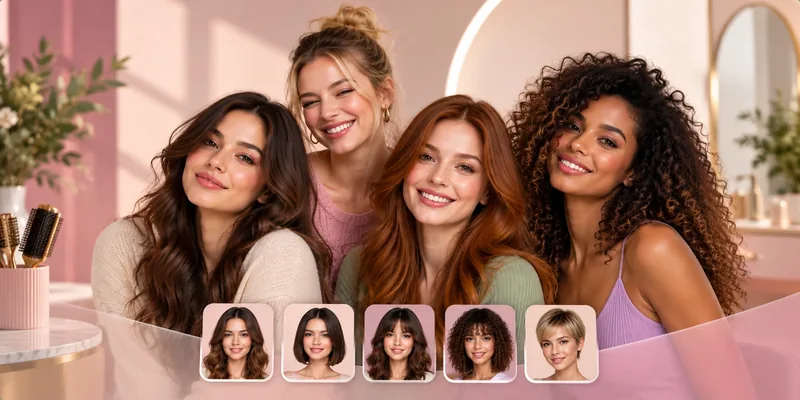
See it on your own face in three taps
- Add one selfie. Front on, even light, hair off your face. No account.
- Pick a cut, a color or a makeup look from 299 in the catalog.
- See it in seconds on your own face, then save it for your stylist.
12 free looks: 4 haircuts, 4 hair colors and 4 makeup looks. No paywall in between, no account.
Questions people ask
How do I find my hair type?
What is the difference between hair type and hair density?
Can my hair type change over time?
Why does hair type matter for choosing a haircut?
Read next

1b hair: what it is, how to style it, and which cuts hold

1c hair: the straight hair with a bend, and how to cut it

Type 3b hair: springy curls and the cuts that keep their shape

4b vs 4c hair: how to tell them apart and style each

1a hair: the straightest type, and the cuts that give it shape
Printable helpers for this guide: haircut consultation checklist, face shape guide, hair color swatch planner.