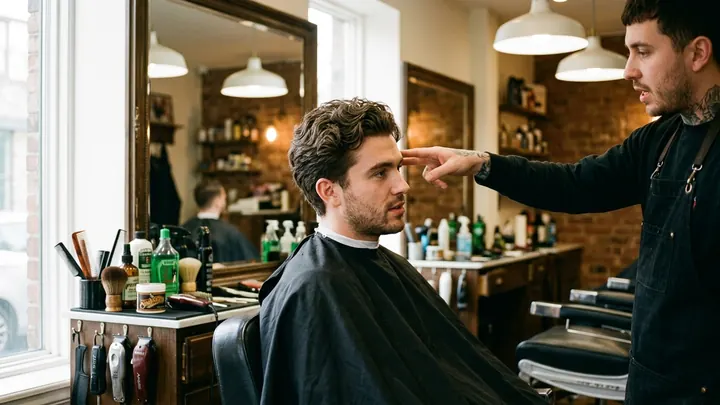
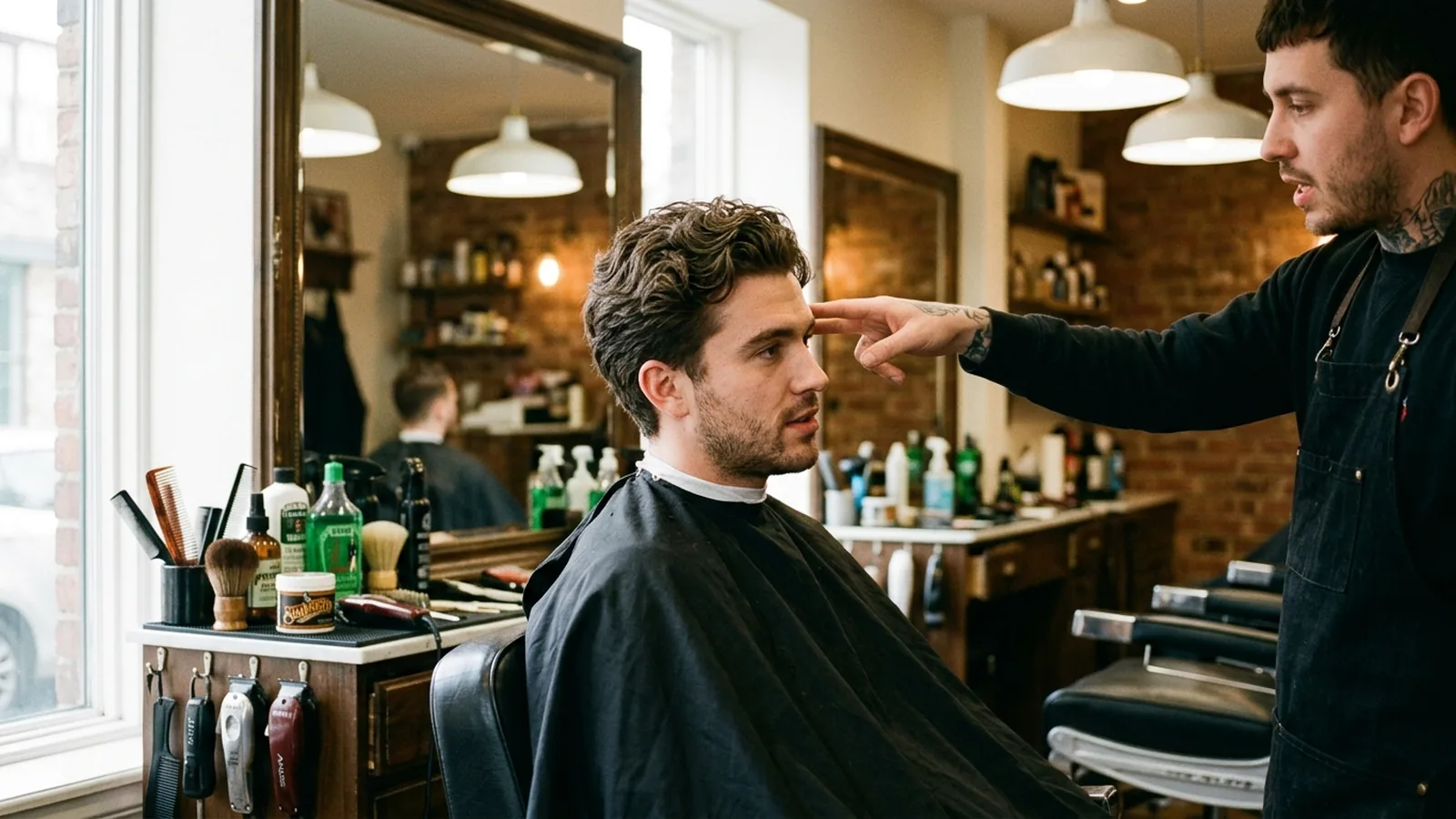
Knowing how to describe a haircut to a barber is a skill on its own, separate from knowing what haircut you want. Plenty of haircut disappointment comes not from a bad barber, but from a description that meant one thing to you and something different to the person holding the clippers.
 Pompadour
 Buzz Cut
 Buzz Cut Fade
Here is the vocabulary, numbers, and landmarks that close most of that gap, plus why a photo of yourself works better than a photo of a stranger. None of it requires memorizing a full barbershop glossary. A handful of specific habits, used consistently, close most of the distance between what you picture and what ends up on your head.
The vocabulary you need to describe a haircut to a barber
Vague words are the biggest source of miscommunication in a barber chair. "Short on the sides" can mean a skin fade to one barber and a gentle taper to another. Learning a handful of specific terms closes most of that gap.
A fade blends the sides and back down gradually, described by where it starts, low, mid, or high on the head, and how far it goes: bare skin for a skin fade, or gentler as a taper. A burst fade curves around the ear rather than running in a straight line, and a drop fade dips lower behind the ear. An undercut is different from a fade: the sides and back are clipped very short with a sharp, deliberate line separating them from longer hair on top, not a gradual blend.
Layers are sections cut to different lengths for movement, with face-framing layers referring to shorter pieces around the face. A slick back is longer top hair combed straight back and held with product, often over faded or undercut sides. A pompadour sweeps that same top volume up and back in a smoother, taller shape, and a quiff is a looser, more textured version of it. Curtains, sometimes called a middle part, describes longer top hair parted in the center and falling to each side.
Here is a quick translation guide from common vague phrases to language that gets a more reliable result:
| What people often say | What to say instead |
|---|---|
| "Short on the sides" | A specific guard number, or "low taper" versus "skin fade" |
| "A little off the top" | An amount in inches, or a landmark like "an inch above my eyebrows" |
| "Not too short" | The guard number or length you wore last time that you liked |
| "Something like this" (a stranger's photo) | A photo of your own previous haircut, plus what should change |
| "Just clean it up" | Which areas specifically: neckline, sideburns, around the ears |
Use guard numbers, not just words like short or long
If any part of your cut involves clippers, guard numbers are the single most precise thing you can say. Guards are numbered, and each number corresponds to a specific length: a #1 is very short and close to the scalp, a #4 leaves noticeably more length. Saying "a #2 on the sides" removes the ambiguity that "pretty short" would leave open.
Our full haircut numbers chart breaks down exactly what each guard number leaves behind, so you walk in already knowing the number you want. To see the difference a couple of guard numbers makes on an actual head, the buzz cut and buzz cut fade catalog pages show two versions side by side.
Point to landmarks on your own head
Numbers work well for clipper length, but for everything else, physical landmarks on your own head are more useful than descriptive words. Instead of saying you want your hair "shorter," point to exactly where you want the length to change: above the ear, level with the earlobe, at the jawline, or at the collarbone.
This matters even more for length at the back and sides, since what looks like "medium length" to you in a mirror might read completely differently to someone standing behind you with a comb. If you are asking for a fade, point to roughly where you want the blend to start. If you are asking for length on top, hold up your fingers to show approximately how much length you want left.
The same approach works for bangs. Instead of saying you want them "shorter," point to where on your forehead you want the line to land, at your eyebrows, above them, or grazing your lash line. For a side part or a fringe pushed to one side, point to which side and roughly how far over you want the part to sit.
Mistakes that lead to a haircut you did not ask for
A few recurring communication mistakes explain most cases of walking out with something other than what you pictured.
- Using length in inches without a reference point. Two inches off the top means something different depending on your current length. Anchor any measurement to a landmark, such as "two inches shorter than it is now" rather than a number on its own.
- Assuming your barber remembers your last visit exactly. Even a regular barber sees many clients between your visits. If something specific worked well last time, say so directly rather than assuming it will be repeated automatically.
- Not correcting course partway through. If the first few minutes of a cut are heading somewhere you did not intend, say something right away, before more length comes off. Adjusting a cut in progress is much easier than fixing one already finished.
- Describing the cut you want instead of the problem you are solving. If your goal is really "make my cowlick behave" or "make my hair easier to manage in humidity," say that directly. A barber can often solve the underlying problem more effectively than they can guess it from a style name alone.
- Leaving out what you do with your hair day to day. Whether you blow dry, air dry, or use product regularly changes how a cut should be shaped to look its best with your actual routine, not just in the chair.
Bring a reference photo of yourself, not a stranger
A reference photo is one of the most useful tools you can bring to an appointment, but the photo you choose matters enormously. A photo of a cut on someone else's face and hair only tells your barber what that specific style looked like on that person, not how it will translate onto your face shape, hair density, and texture.
A photo of a cut you have actually worn, even an old one, gives your barber proof of how a similar length and shape sat on your own head. No old photo of the exact cut you want? The next best thing is a photo of your current hair alongside a clear description of what should change and what should stay the same.
Say what you did not like about your last cut
Barbers can often solve a problem faster and more accurately than they can execute a vague vision described only in the abstract. Instead of only describing what you want, describe what specifically went wrong with your last cut: too much taken off the top, a fade that started too high, or bangs cut shorter than you expected.
This kind of feedback gives your barber a concrete target to adjust from, rather than starting from scratch with only a general idea of your preferences. Run through your last two or three cuts in your head before any appointment and note anything you would change, even small things. Patterns show up quickly, a fade that always starts too high, bangs that never quite land where you want them, and naming that pattern directly is often more useful than any single reference photo.
How often to come back so the cut holds its shape
Part of describing what you want is being upfront about how often you can realistically get back in the chair. Short, structured cuts like fades and buzz cuts typically need a trim every 3 to 5 weeks to hold their shape, while longer, layered cuts can usually stretch to every 8 to 12 weeks.
Telling your barber your realistic schedule upfront lets them shape the cut so it grows out reasonably, instead of looking sharp for a week and messy for the rest of the month. Our guide on how often to get a haircut covers this in more detail across different cut types.
Mention this at the very start of the appointment, before any cutting begins, not partway through. A barber who knows you are planning to stretch six weeks between visits can build in extra length and softer lines to account for the growth in between, a different approach than cutting a style meant to look its sharpest on day one.
What to say if you are growing something out
Growing out a previous cut is its own kind of conversation, since the goal is not a finished look but a transitional shape that stays wearable while the length you want catches up. Be specific about the end goal and how much time you are willing to give it, since your barber can shape the in-between stages very differently depending on whether you want to get there in three months or a year.
If you are specifically growing out a buzz cut, our guide on how to grow out a buzz cut walks through what to expect and what to ask for at each stage. Growing out an undercut brings its own awkward phases too, covered separately in our guide to growing out an undercut.
Ask specifically for a "maintenance cut" during the growing-out phase rather than a full restyle. This tells your barber to trim only what is needed to keep the shape presentable, taking off as little length as possible while things even out. It is a different request from a normal haircut, and worth naming outright so you do not end up with more taken off than you intended, especially with a barber you have not seen before.
A quick note before you sit down: a fresh haircut also changes how your regular products behave for a few days, so do not judge the final shape from the first wash alone. Give it a couple of days of your normal routine before deciding whether it matches what you asked for.
See the exact look on your own face before you go
The clearest way to communicate a haircut is to show your barber exactly what you want on your own face, not describe it in words alone. HairGlam lets you take a photo or choose one from your library, apply a cut from a catalog of 299 styles, and see the result rendered onto your own photo in a few seconds. Save the result and bring it in as your reference photo, since it shows your barber the cut on your actual face and hair rather than a stranger's. The app is free to download, with a couple of free try-ons before HairGlam Pro unlocks unlimited use.
See it on your own face in HairGlam
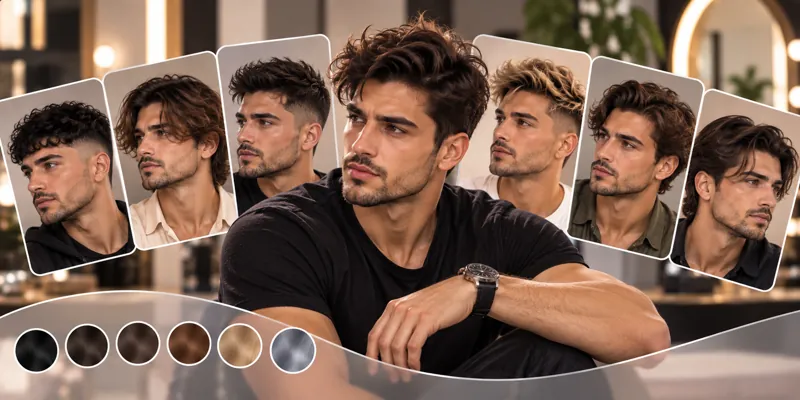
See it on your own face in three taps
- Add one selfie. Front on, even light, hair off your face. No account.
- Pick a cut, a color or a makeup look from 299 in the catalog.
- See it in seconds on your own face, then save it for your stylist.
12 free looks: 4 haircuts, 4 hair colors and 4 makeup looks. No paywall in between, no account.
Questions people ask
What should I say to my barber to get the cut I want?
Why did my haircut not turn out how I described it?
Should I bring a reference photo to the barber?
How do guard numbers work?
Read next
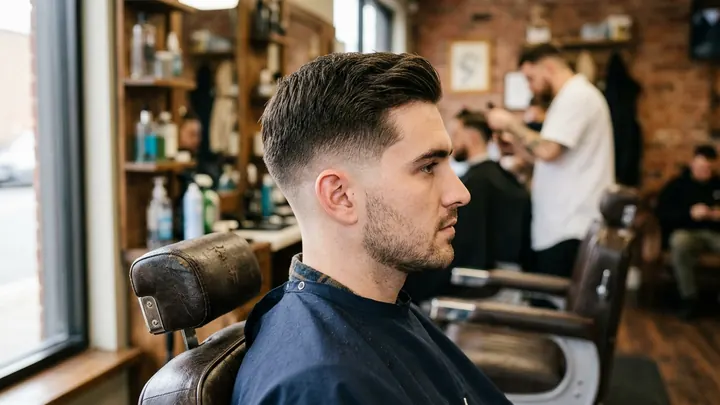
Haircut numbers chart: what a 1, 2, 3 and 4 actually look like
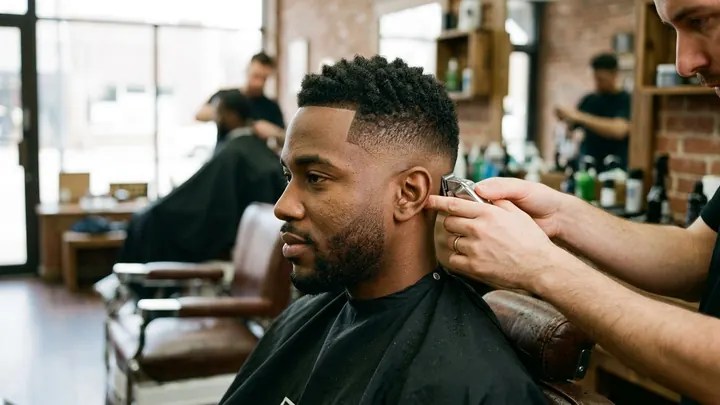
How often to get a haircut, by cut length and hair type
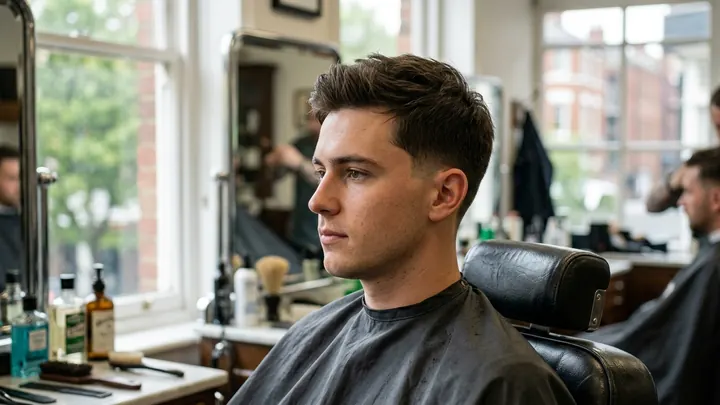
How to grow out a buzz cut without the mushroom phase
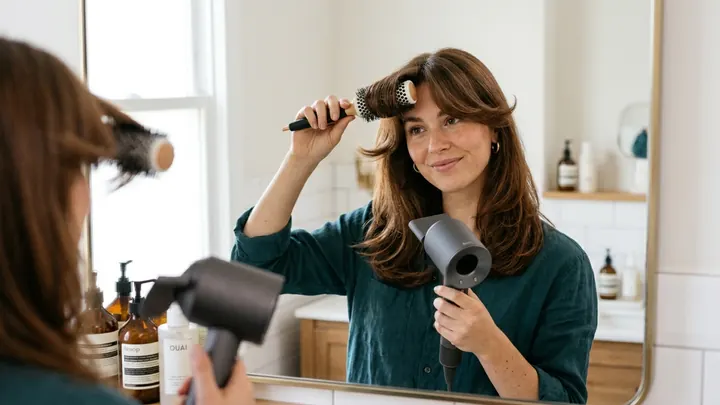
How to style curtain bangs: blow dry, round brush, and the lazy way
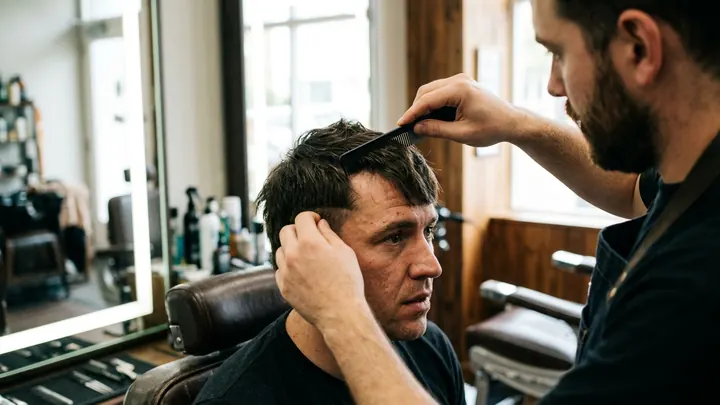
How to fix a bad haircut: what a second barber can and cannot do
Printable helpers for this guide: haircut consultation checklist, face shape guide, hair color swatch planner.