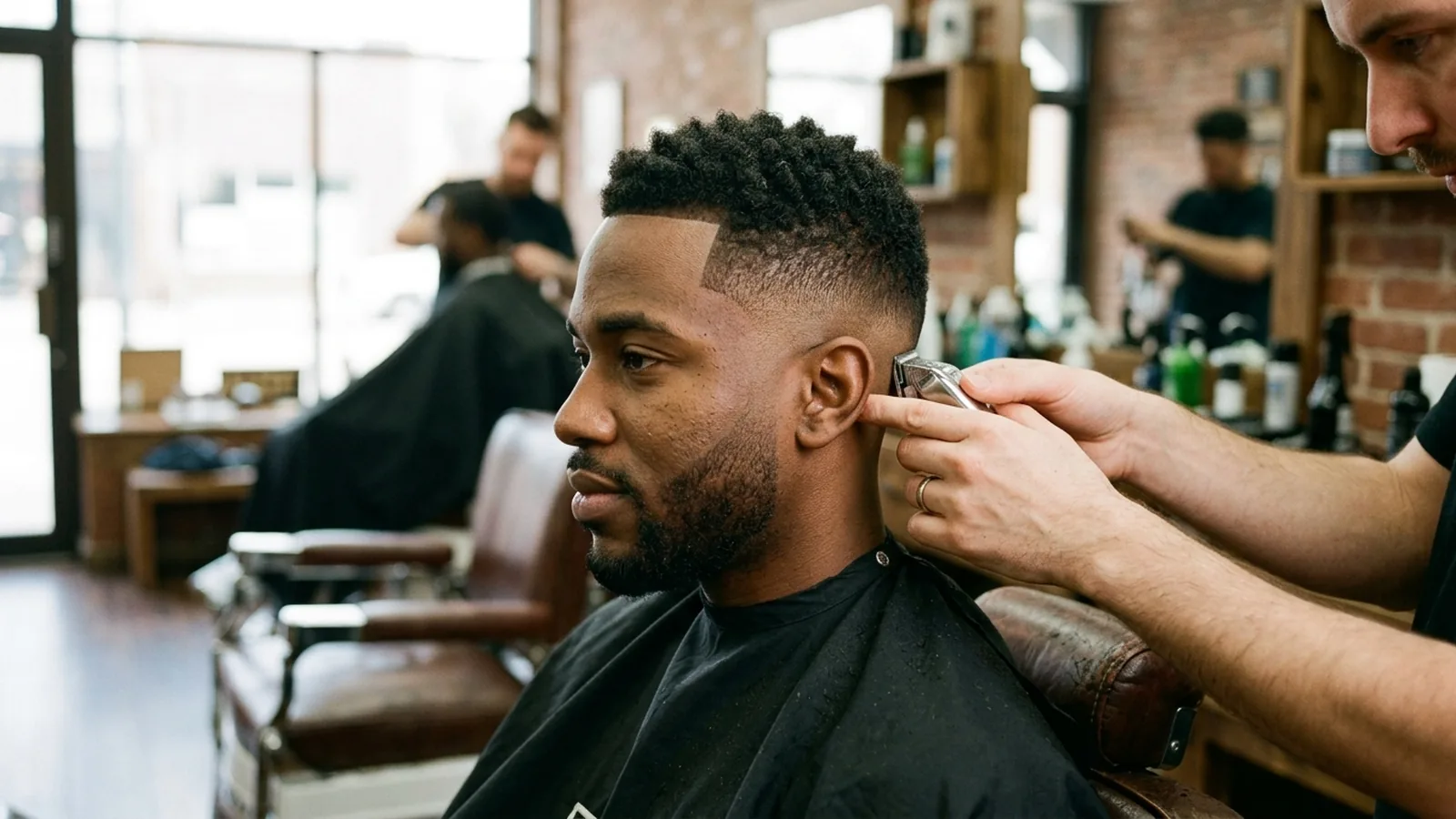
A buzz cut, a bob, and long layered hair all grow out in completely different ways, so how often to get a haircut is not really one question. Hair grows at roughly the same rate for almost everyone, about half an inch a month on average, but how noticeable that growth is depends entirely on how short the cut is and how sharp its lines are. Here is the typical range for the most common cuts, and why some need attention so much more often than others.

See any cut or color on your own photo. Free to download, iPhone and iPad, iOS 15.1 or later.
 Buzz Cut
 Box Braids
 Buzz Cut Fade
 Layered Bob
 Blunt Bob
How often to get a haircut, the quick answer by cut length
| Cut type | Typical interval |
|---|---|
| Short cuts (pixie, crop, buzz, fades) | every 3 to 5 weeks |
| Bobs and lobs | every 6 to 8 weeks |
| Long layered hair | every 8 to 12 weeks |
| Bangs, on their own | every 3 to 4 weeks |
| Box braids or locs | every 6 to 8 weeks |
These are typical ranges, not fixed rules. Faster hair growth, a very precise style, or an active lifestyle can all push you toward the shorter end of any range above. Someone who works out daily and wears a short fade, for example, usually notices the line softening faster than someone with the same cut and a quieter schedule, simply because more washing and more sweat both speed up how quickly a precise style starts to look soft around the edges.
It also helps to separate two different reasons for a haircut: keeping a shape you already like, and changing to something new. The ranges above are for maintaining a style you are already happy with. If you are moving from one cut to a shorter or more different one, that timeline depends entirely on how much hair needs to come off, not on any typical interval.
Why fades and short cuts need more frequent trims than bobs
A short cut shows regrowth faster for a simple reason: half an inch of new growth is a much bigger proportion of a one-inch buzz cut than it is of shoulder-length hair. A fade makes this even more noticeable, since the whole point of a fade is a gradual, precise gradient from skin to hair, and that gradient visibly creeps down and blurs within a few weeks as the shortest hair near the neckline grows out unevenly. A buzz cut fade usually needs attention closer to the 3-week end of the range for exactly this reason, while a looser, less precise short style can often stretch closer to 5 weeks.
Longer, layered hair can go longer between cuts
Long layered hair holds its shape for longer, typically 8 to 12 weeks, because the layers were already cut with some room to grow before the shape starts to look noticeably different. Split ends are the main thing to watch for on longer hair rather than an obvious change in shape, since damaged ends can make hair look thinner and less healthy well before the overall length or layering looks off. A layered bob sits in between: it holds its shape longer than a blunt bob but still typically needs a trim every 6 to 8 weeks to keep the layers looking intentional rather than grown out.
Bangs run on their own schedule
Bangs typically need a trim every 3 to 4 weeks, regardless of how often you get the rest of your hair cut. Many salons will do a quick bang trim on its own between full haircuts, since bangs grow into your eyes and change shape faster than hair anywhere else on your head.
If you are growing bangs out entirely, expect it to take 6 to 12 months to reach chin length, depending on your hair's growth rate.
Color adds its own timeline
A haircut and a hair color are two separate maintenance schedules, and it helps to think of them that way instead of trying to line them up. A full-head permanent color typically needs a root touch-up every 4 to 6 weeks, since new growth at the root shows as a visible line against the rest of the color. Balayage, which is painted onto the surface with a softer, more gradual regrowth line, usually only needs a refresh every 3 to 5 months. A toner or gloss fades faster than either, typically needing to be redone every 4 to 8 weeks, and any vivid or pastel color fades noticeably within 2 to 6 weeks even with a color-safe routine.
What to tell your barber to keep the schedule on track
The easiest way to stay on a consistent schedule is to ask your barber or stylist directly what interval they would recommend for your specific cut, since they can see how fast your hair grows and how precise your particular style needs to be. Our guide on how to talk to your barber covers the specific language that gets a consistent result visit after visit, which matters just as much as the timing.
If you are growing something out instead
Not every haircut decision is about staying on schedule.
If your last cut did not turn out right
If the real reason you are asking about timing is that your last haircut did not turn out the way you wanted, timing alone will not fix that.
See your next cut on your own face first
Whatever your schedule ends up being, it helps to know what you are asking for before you sit down. HairGlam lets you take a photo or choose one from your library, then apply a hairstyle to that photo so you can see a fade, a bob, or a longer layered cut on your own face before your next appointment. It is free to download for iPhone and iPad, with a small free allowance of hairstyle try-ons before HairGlam Pro is needed for unlimited use.
See your next haircut on your own face in HairGlam
See it on your own face in three taps
- Add one selfie. Front on, even light, hair off your face. No account.
- Pick a cut, a color or a makeup look from 299 in the catalog.
- See it in seconds on your own face, then save it for your stylist.
Free hairstyle, hair color and makeup looks to start. No account needed.