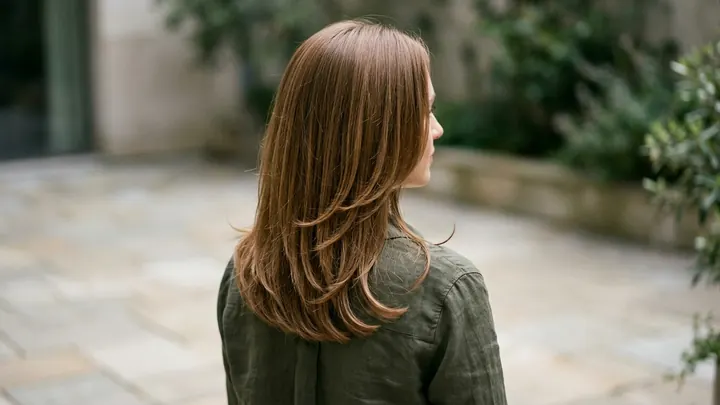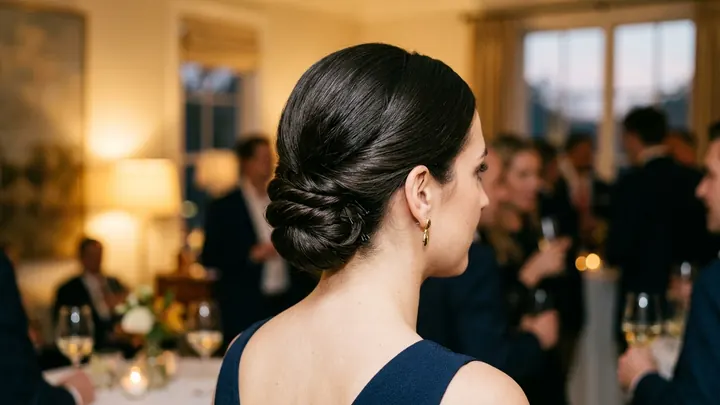
Move your part from the side to dead center and your whole face reads differently. A middle part shifts how symmetrical your face looks, exposes more of your hairline, and can make a cowlick that used to hide itself suddenly obvious. Here is who suits a center part, how to deal with a stubborn cowlick, how long it takes to train the switch, and the cuts that carry a middle part best for both women and men.

See any cut or color on your own photo. Free to download, iPhone and iPad, iOS 15.1 or later.
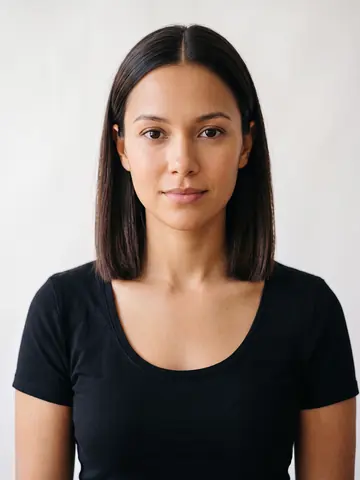 Blunt Bob
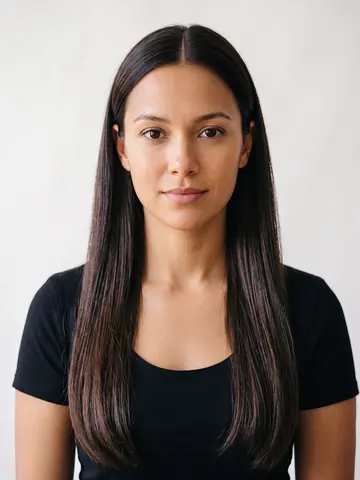 Long Straight Hair
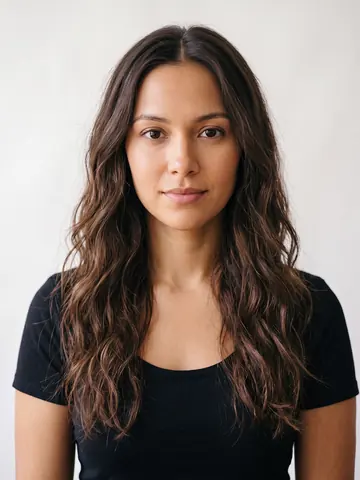 Long Beach Waves
 Curtain Bangs on Medium Hair
Why a middle part changes the whole look
A side part naturally creates asymmetry, with more volume falling on one side than the other, which softens angles and can hide a slightly uneven hairline. A middle part does the opposite. It splits the face exactly in half, drawing attention to true symmetry, or the lack of it, and showing off bone structure more directly. That is exactly why the switch is worth testing before you commit to it as your everyday look.
Which face shapes suit a middle part
An oval face suits a middle part with almost no adjustment, since an oval works with nearly any parting or length and the real decision factors are hair texture, density, and how much styling time you want to give it. A round face needs more care: a flat, center part with no lift at the crown widens a round face rather than adding the vertical line that flatters it.
If you are working with a different face shape, test a middle part on your own photo before you decide, since the effect varies more with hair texture and length than with shape alone.
The cowlick problem
A cowlick is a small area where hair grows in a spiral, pushing the surrounding strands in a direction that fights whatever part you are trying to create. A middle part sits right in the most common cowlick location for a lot of people, at the crown or front hairline, which is why a part that looked fine off to the side suddenly looks lifted or uneven once moved to the center. The fix is usually blow drying the roots in the opposite direction from the cowlick's natural pull while the hair is damp, then setting that direction with a light hold gel or mousse before it dries completely. A strong cowlick rarely rules out a middle part entirely. It just means the first few weeks take more deliberate styling.
How to train a middle part over two weeks
Hair holds a kind of memory from years of falling the same direction, so switching a part is rarely instant. Comb your hair into the new center part every day, even on days you are not fully styling it, and use a small amount of product at the root to discourage it from drifting back to the old line. Sleeping with a silk or satin cap, or at least avoiding a pillowcase that grips hair overnight, preserves the direction while you sleep instead of undoing the day's work.
Most people find that after about 1 to 2 weeks of daily repetition, the new part holds with much less effort, and by the time the hair around the old part line has grown out a little, the switch feels close to automatic.
Haircuts that carry a middle part well
Some cuts show off a center part more naturally than others. Long, straight styles like a straight long length or soft beach waves also carry a center part easily, since there is enough length on both sides to balance out. If your cut leans on layers for movement, a center part still works, though heavier layering right at the part line can make the two sides look slightly uneven if they are not cut carefully to match.
Not every cut needs to lean into a center part.
Middle parts and curtain bangs
A middle part is also the starting point for curtain bangs, which part in the center and sweep out to each side rather than falling straight down over the forehead. If you already wear a middle part in the rest of your hair, curtain bangs are usually an easy addition since the part line at the front already matches. Growing bangs into curtains from a blunt, straight-across fringe takes a few months, since there needs to be enough length for the two sides to sweep back rather than sit flat against the forehead.
Middle parts for men
The men's version of a middle part usually goes by the name curtains: a longer top, generally with enough length to fall past the eyebrows, parted in the center and left to fall to each side rather than combed back or over. It works best with hair that has at least a little natural wave or texture, since fully straight hair can look flat when split evenly down the middle. Growing the top out to curtain length typically takes a few months from a shorter starting cut, with the sides usually kept shorter or faded for contrast.
See it on your own face before you commit
A middle part is one of the easier changes to preview before you make it, since it does not require cutting anything. HairGlam lets you take a photo, or choose one from your library, then apply a hairstyle to that photo so you can see how a center part reads on your own face and hairline before you spend two weeks training it in. It is free to download for iPhone and iPad, with a small free allowance of hairstyle try-ons before HairGlam Pro is needed for unlimited use.
See a middle part on your own face in HairGlam

Try middle part on your own photo
- Add one selfie. Front on, even light, hair off your face. No account.
- Tap middle part in Hair Studio, or any of the other 298 looks.
- See it in seconds on your own face, then save it for your stylist.
Free hairstyle, hair color and makeup looks to start. No account needed.