
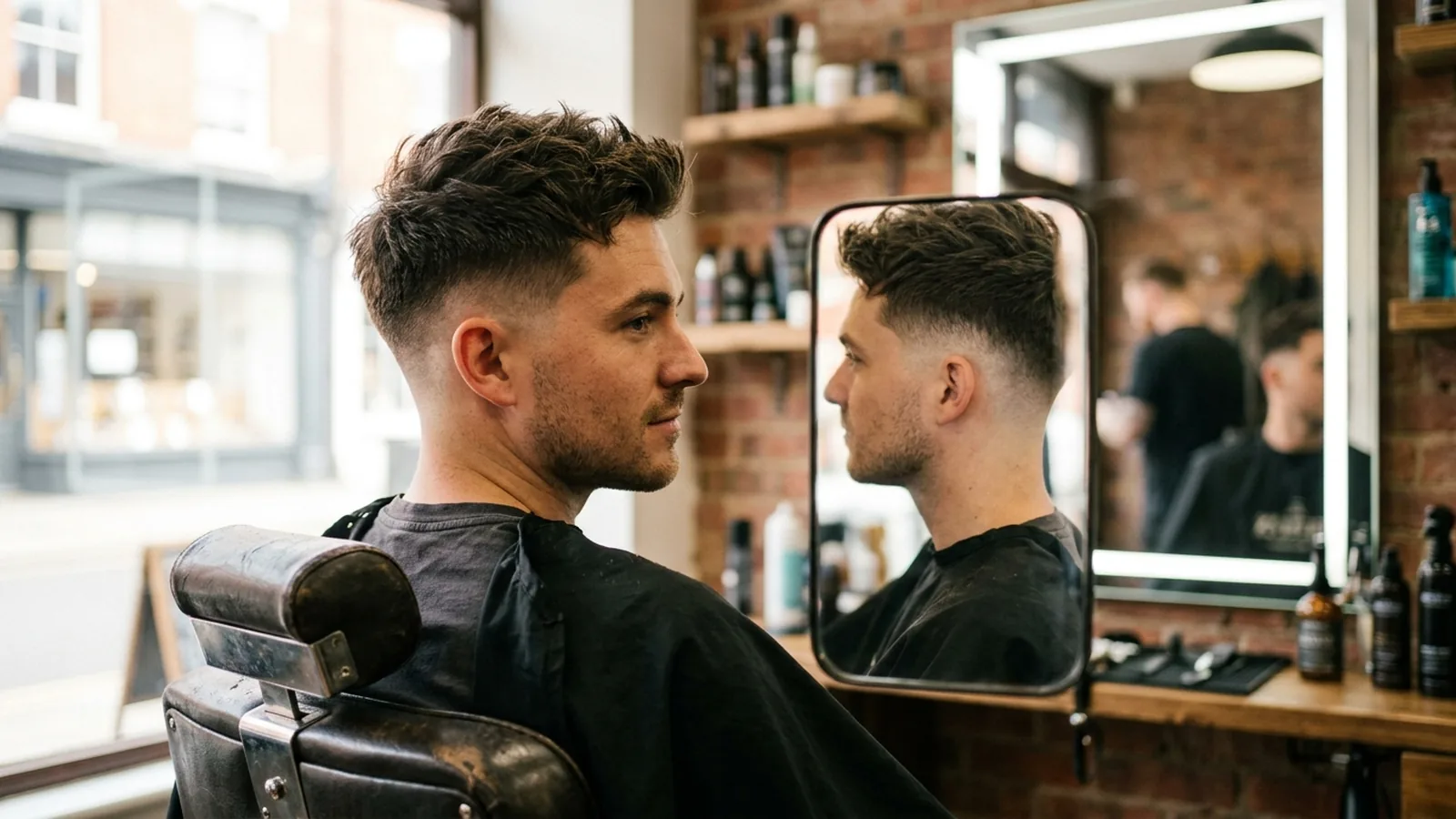
Walking into a barbershop without the right words can turn a five-minute conversation into a haircut you did not ask for. This guide covers 25 men's haircut types, grouped by category, with a plain-language definition and exactly what to say to get each one.
Every cut here is defined the way a barber would use the term, so you can point to a section, use its name, and know you are asking for the same thing your barber is picturing. Once you know the vocabulary, the harder part becomes narrowing it down, which is where checking a few options against your own face comes in.
Buzz cuts and fades
Fades are the most requested category in most barbershops, and the terminology around them trips people up more than any other group of cuts.
Buzz cut
A buzz cut is one clipper length over the entire head, with no blending or fade. Guards are numbered, so a #1 is very short and close to the scalp, while a #4 leaves noticeably more length. Ask for a buzz cut by guard number, for example "a #2 all over," to get a consistent, low-maintenance result. See the look on the buzz cut catalog page.
Skin fade
A skin fade takes the sides and back all the way down to bare skin at the bottom, blending gradually into more length up top. It is the sharpest, highest-contrast version of a fade. Ask for a "skin fade" specifically, since a regular fade can stop short of bare skin.
Low fade
A low fade starts the blend low, near the bottom of the sideburns and the nape of the neck, leaving more length through the rest of the sides. It is a subtler look that works well in more conservative settings.
Low taper fade
A low taper fade combines a taper's gentler blend with a fade's finish, starting low and staying close and neat around the ears and neckline. It is one of the most versatile fades because it works with almost any length on top. Read the full breakdown in our guide to the low taper fade.
Mid fade
A mid fade starts the blend around the temple, roughly midway up the side of the head. It gives more contrast than a low fade without the boldness of a high fade.
High fade
A high fade starts the blend high on the side of the head, close to where the top length begins, creating the most dramatic contrast between short sides and longer top.
Burst fade
A burst fade curves around the ear rather than running in a straight line, so the fade "bursts" outward near the ear before continuing. It pairs especially well with curly or coily top lengths.
Drop fade
A drop fade dips lower behind the ear compared to the rest of the fade line, following the natural curve of the head rather than a straight line. It is a popular choice with textured or curly cuts on top.
Short and textured cuts
These cuts keep the sides tidy while giving you more to work with on top than a straightforward buzz or fade.
Textured crop (French crop)
A textured crop, also called a French crop, pairs short sides with a short, textured top and bangs pushed forward toward the forehead. Ask for "short textured sides with bangs pushed forward" to describe this shape clearly at any barbershop.
Two block
A two block cut has undercut or heavily faded sides and back with a longer, disconnected top that sits over them rather than blending in. It is common in Korean men's styling and gives you room to style the top separately from the sides.
Crew cut
A crew cut is short and tapered all around, slightly longer on top than a buzz cut but still tidy and low-maintenance. It is one of the easiest cuts to maintain between trims.
Flat top
A flat top clips the top hair into a flat, level plane, usually with tapered or faded sides underneath for contrast. See an example on the flat top catalog page.
Undercut
An undercut shaves or clips the sides and back very short, with a clear, deliberate line separating them from noticeably longer hair on top. Unlike a fade, the transition is sharp rather than gradual.
Slicked back undercut
A slicked back undercut pairs the sharp undercut sides with longer top hair combed straight back and held in place with product. It is a strong, polished look for both daily wear and dressier occasions. We cover it in detail in our guide to the slicked back undercut.
Classic and business cuts
These are the cuts most associated with office settings and formal occasions, though plenty of people wear them every day.
Slick back
A slick back is longer top hair combed straight back and held with product, often worn over faded or undercut sides. It is less about a specific length and more about the styling direction.
Pompadour
A pompadour sweeps volume up and back from the forehead in a smooth, tall shape, usually with shorter sides for contrast. See it styled on the pompadour catalog page.
Quiff
A quiff is a looser, more textured cousin of the pompadour, with volume swept up and back but a messier, less polished finish.
Curtains (middle part)
A curtains cut, or middle part, keeps the top hair longer and parts it in the center so it falls to each side, framing the face like a set of curtains.
Ivy league
An ivy league, sometimes called a Harvard clip, is a slightly longer take on the crew cut with enough length on top to be styled with a side part or brushed back.
Comb over
A comb over combs the top hair to one side over a shorter section beneath it, with the sides tapered or faded to support the shape. Ask for "a comb over with a taper" for a modern version rather than an old-fashioned flat one.
Executive contour
An executive contour is a precise, office-friendly cut that uses strategic length and a defined part to add visual density on top, which is why it is often recommended to men dealing with a receding hairline. Our full guide to the executive contour haircut covers exactly how it differs from a standard side part.
Edgar
An Edgar cut pairs a very straight, blunt line of bangs across the forehead with a high skin fade on the sides. It is a bold, graphic look that depends on precise cutting to hold its shape.
Long, textured, and retro cuts
These cuts trade the tidy sides above for more length, movement, and personality.
Mullet
A mullet is short at the front and sides with noticeably longer hair left at the back. See the classic version on the mullet catalog page.
Modern mullet
A modern mullet softens the sharp contrast of a classic mullet with texture and blending, making the transition from short to long less abrupt.
Shag
A shag uses heavy layering throughout the head for a lot of texture and movement, often paired with bangs. It photographs messier by design.
Wolf cut
A wolf cut blends a shag with a mullet, featuring a shorter, textured crown and longer layered length at the back and sides.
Mohawk
A mohawk keeps a strip of longer hair running from the front to the back of the head, with the sides shaved, buzzed, or faded down to nothing.
Natural texture and length
For coily and curly hair, these styles work with the hair's natural pattern rather than against it.
Afro
An afro is natural coily hair worn out and shaped, usually into a rounded silhouette. See it on the afro catalog page.
Twists
Twists are formed by twisting two strands of hair around each other, creating a defined, textured look that can be worn short or long.
Cornrows
Cornrows are braided flat against the scalp in neat rows, a style that works for a wide range of hair lengths and lasts several weeks with care. See an example on the cornrows catalog page.
Locs
Locs form when sections of hair are matted together into ropes over time. They can be worn short or grown long, and require specific maintenance to keep the roots neat as new growth comes in.
Match the cut to your hair type and face shape
Not every cut in this list works the same way on every head. Straight hair holds crisp lines well, which is why fades, crops, and the executive contour tend to photograph cleanly on straight or slightly wavy hair. Curly and coily hair adds its own texture to a cut, which is part of why burst fades and drop fades, both of which follow the curve of the head rather than a straight line, are popular choices for curl patterns.
Face shape plays a role too, in the same way it does for women's cuts. Round faces generally benefit from added height at the crown and a defined side part, both of which a pompadour or quiff naturally provide. Square faces tend to suit cuts with some texture and movement on top, like a shag or a textured crop, rather than very geometric, hard-edged shapes. If you want the full geometry behind this reasoning, our guide to the best hairstyle for your face breaks down all six face shapes in detail, and applies just as much to men's cuts as women's.
How to talk to your barber about men's haircut types
Once you know the name of the cut you want, the rest of the conversation is about specifics: where the length changes, how short the guard number should go, and how much length to leave on top. Bring a photo if you have one, and be ready to say what you did not like about your last cut, since that tells your barber as much as any reference photo does.
It also helps to know your own maintenance limits before you sit down. Short, structured cuts like fades and crops typically need a trim every 3 to 5 weeks to hold their shape, while longer, looser cuts like a shag or a modern mullet can usually stretch further between visits. Telling your barber upfront how often you can realistically come back lets them shape the cut to grow out well, instead of looking sharp for a week and messy for the next month.
See any of these on your own face first
Reading twenty-five definitions is one thing. Knowing which ones will actually suit your face and hair is another. HairGlam lets you take a photo or choose one from your library, apply a cut from the catalog of over 240 hairstyles and colors, and see the result on your own photo in a few seconds, keeping your face and skin tone intact. Save the ones you like and bring them to your next appointment as a reference. The app is free to download, with a couple of free try-ons before HairGlam Pro unlocks unlimited use.
See it on your own face in HairGlam
Key takeaways
- Fades are named by where the blend starts (low, mid, high) and how far it goes (taper versus skin fade), so use both terms together for the clearest request.
- Short, structured cuts like the crew cut and executive contour suit conservative settings, while mullets, shags, and wolf cuts trade structure for texture and personality.
- Natural texture cuts like afros, twists, cornrows, and locs work with coily and curly hair rather than against it.
- Bring a reference photo and specific guard numbers to your barber appointment to reduce the chance of miscommunication.
- A photo preview on your own face is the most reliable way to narrow twenty-five options down to the two or three worth actually asking for.
Questions people ask
What are the best haircuts for men right now?
What is the difference between a fade and a taper?
How do I explain a haircut to my barber?
How often do men need a haircut to keep the shape?
Read next
Slicked back undercut: how to ask for it and keep it sharp
Executive contour haircut: the office cut that hides a recession
Low taper fade: what it is, who it suits, what to tell the barber
Modern mullet: how the 2020s version differs and who can pull it off
Burst fade: the curved fade behind the ear, and who it suits
Printable helpers for this guide: haircut consultation checklist, face shape guide, hair color swatch planner.