Before you start, one thing worth saying out loud: the label is a means to an end. Knowing you are a heart shape is only useful because it narrows down which haircuts are worth looking at, and that narrowing is rough at best. If the real question is what haircut suits your face, measuring is step one, not the answer. Do it anyway, because a shortlist beats scrolling.
Method one: four measurements and a mirror
You need a soft tailor's tape, the kind used for sewing. If you do not have one, cut a piece of string for each measurement, pinch it where it ends, then lay it flat against a ruler. A rigid metal tape does not bend around a face and will give you nonsense.
Set yourself up properly first
Tie all of your hair back and off your face, including the pieces at your temples and any bangs. Hair beside your jaw can add a centimeter to the one measurement that decides between oval and square, and bangs hide where your hairline actually starts.
Stand square to a mirror with your head level, ears at the same height, eyes forward and your face relaxed with your mouth closed. Even light from the front is best. A lamp off to one side carves shadows under your cheekbones that make you read your own face wrong.
Take the four measurements
- Forehead at its widest. For most people the widest point is roughly halfway between the top of the eyebrows and the hairline. Run the tape straight across from one side to the other. Keep it flat, do not follow the curve of your skull around the sides.
- Cheekbones. Start at the outer corner of one eye, run the tape across the top of the cheek over the highest point of the cheekbone, and finish at the outer corner of the other eye.
- Jawline at its widest. Find the corner of your jaw on each side, just below the earlobe and slightly forward, where the bone turns and angles up toward the ear. Press with a fingertip until you feel it. Measure straight across from one corner to the other, the same way you measured your forehead. Keep the tape flat and off the skin instead of following the curve of the jaw, because a tape wrapped around the outline measures a longer path than a straight width and gives you a number you cannot compare against the other three.
- Face length. From the center of your hairline, straight down the middle of your face over the nose, to the tip of your chin.
Write all four down in the same unit, and take each one twice. If the two readings differ by more than a few millimeters, something moved: usually your head tilted, or the tape slipped off the widest point of the forehead.
Read the four numbers
Now compare the three widths against each other, and compare the length against the cheekbone measurement. The shape falls out of the ratios, not out of any single number.
| Shape | How the four numbers compare | The giveaway |
|---|---|---|
| Oval | Length is about one and a half times the cheekbone width. Forehead is slightly wider than the jaw. | No hard angles anywhere. The line from cheekbone to chin curves gradually and nothing dominates. |
| Round | Length and cheekbone width come out close to each other. Cheekbones are the widest of the three widths. | A soft, rounded jaw with no visible corner below the ear. |
| Square | Forehead, cheekbones and jaw all measure close to the same width. | The jaw is angular. There is a definite corner where the jawline turns and runs up toward the ear. |
| Heart | Forehead is the widest of the three widths. The jaw is the narrowest. | The chin narrows to a point, and there is often a widow's peak at the center of the hairline. |
| Long, also called oblong | Length is more than about one and a half times the cheekbone width. Forehead, cheekbones and jaw all measure close to the same. | It reads like an oval or a square that has been stretched vertically. |
| Diamond | Cheekbones are the widest measurement. Forehead and jaw are both narrower than the cheekbones. | Widest across the eyes, narrow at the hairline, pointed at the chin. |
Plenty of people land between two shapes
This is the part most face shape guides skip, and it is the part that makes people give up. Faces are not stamped out of six templates. It is completely normal to measure square through the jaw and oval through the length, or round in the cheeks with a heart shaped hairline, or long with a jaw that has a real corner in it.
Nothing has gone wrong when that happens. Take the two closest shapes, treat both sets of recommendations as one shortlist, and let the cuts sort themselves out on your head. A hybrid answer is more accurate than forcing yourself into a single box, and it usually gives you a wider set of options rather than a narrower one.
Stuck between two shapes?
That is exactly where a tape measure stops helping. Upload one photo to HairGlam and put the cut you are undecided about on your own face, then judge what you see instead of what the chart says.

Common mistakes that give you the wrong shape
Almost every wrong answer comes from one of these four, and all four are easy to fix.
Measuring with your hair down
Hair sitting beside the jaw pads out the jaw measurement, layers add width at the cheeks, and bangs make the forehead measurement guesswork because you cannot see the hairline. Tie all of it back, then check in the mirror that nothing is still falling forward at the temples.
A tilted head
Tucking your chin down shortens the face length. Lifting it lengthens the face and hides the jaw. Both are enough to move you a whole category, since length against cheekbone width is the ratio doing most of the work. Look straight ahead with your ears level and confirm it in the mirror rather than trusting how it feels.
Smiling
A smile lifts the cheeks, widens the face across the cheekbones and changes the line of the jaw. Measured mid smile, a lot of oval faces come out round. Keep your face relaxed and your mouth closed for all four measurements.
Holding the phone too close
If you are checking with a selfie instead of a mirror, distance matters more than anything else. The front camera uses a wide lens, so whatever is nearest to it gets enlarged. At arm's length or closer that means a bigger nose and forehead and a visibly narrower jaw, which is enough to turn a square face into a heart shape on screen. Prop the phone up, step back further than feels necessary, and use the timer.
Method two: let the AI look at the photo
A tape measure gives you a category. It does not tell you what curtain bangs do to your forehead, or whether a chin length bob lands above or below the widest part of your cheek. Those were the questions the category was standing in for the whole time.
HairGlam gets to the same place from the other direction. You upload one photo, pick a cut or a color, and the app regenerates that photo with the new hair while keeping your face, your hairline and your coloring. Instead of reading that heart shapes suit a side swept fringe, you look at a side swept fringe on your own head and decide in about the time it takes to put the phone down.
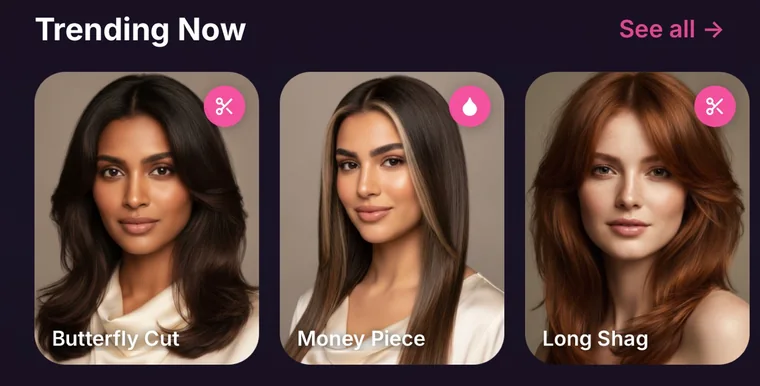
In practice that means the home screen opens on an Upload Photo button in the Hair Studio banner, with rows underneath it: Today's Picks with the Layered Bob, Honey Blonde and Beach Waves, then Trending Now with the Butterfly Cut, Money Piece and Long Shag, then Hair Colors and Celebrity Looks. If you already know the name of what you want, the Discover tab has a search field and filter chips for All, Trending, Bold Color, Bob and Curly, with cards labeled cut then color, like "Long Straight, Espresso" or "Beach Waves, Caramel Highlights".
The reason this is worth doing after you measure, rather than instead of measuring, is that the four numbers tell you which eight cuts to try, and the app tells you which one of the eight actually works on you. There are 138 hairstyles, 125 hair colors and 36 makeup looks in there, so a shortlist is genuinely useful. Face shape has nothing to say about color, so if that is the decision in front of you, start on the hair color try on page instead.
What to do once you have your answer
Take the shape and go straight to the cuts written for it. If you measured round, the useful reading is the best haircuts for a round face, which is mostly about length, side parts and where a bob is allowed to end. If you measured oval, the oval face guide is more interesting than the usual advice that oval suits everything, because it covers what each length does to your proportions rather than what is permitted.
Square, heart, long and diamond all get covered in the what haircut suits me page, along with the try on flow for testing any of it on your own photo. The rest of the guides, including a hands on test of the AI hairstyle apps, are in the blog index, and the HairGlam home page explains how the try on works end to end.